

Abstract
Background
Patients with BRAF 600E mutated mCRC are associated with specific clinicopathological features and poor prognosis. The relative efficacy of first-line FOLFOXIRI triplet chemotherapy or doublet chemotherapy combined with bevacizumab in patients with BRAF 600E mutated mCRC remains controversial.
Methods
BRAF V600E-mutated mCRC patients from 3 institutions were included. The clinicopathological characteristics of the enrolled patients were analyzed. Overall survival (OS) of patients was divided into 4 fractions, including 0–25%, 25-50%, 50-75%,75-100% by quartile method. Patients with OS ranging from 0 to 25% were defined as the poor prognosis group, and patients with OS ranging from 75 to 100% were defined as the good prognosis group. A propensity score matching (PSM) analysis was performed to balance the baseline characteristics of patients treated with doublet chemotherapy and triplet chemotherapy combined with bevacizumab. Survival and tumor response of the two regimens were evaluated.
Results
A total of 125 patients with BRAF V600E-mutated mCRC were enrolled. The median OS of BRAF V600E-mutated mCRC was 14.9 months and the median PFS of first-line therapy was 6.1 months. According to the multivariate analysis and the difference in baseline characteristics between the poor prognosis group and the good prognosis group, poor differentiation and liver metastasis were negative independent prognostic factors for OS in patientsx with BRAF V600E-mutated mCRC. Patients treated with first-line triplets had a longer OS than those treated with doublets both before PSM (17.4 months vs. 13.4 months, p = 0.022) and after PSM (17.4 months vs. 10.4 months, p = 0.004). There was no significant benefit between triplet-drug group and doublet-drug group for PFS, ORR and DCR. Subgroup analysis showed that patients in the triplet-drug group had a better prognosis with the following favorable factors: age ≤ 60 years old, PS score of 0–1, liver metastases and multiple organ metastases.
Conclusion
The overall prognosis of BRAF V600E mutant mCRC patients is poor. Poor differentiation and liver metastases were negative independent prognostic factors for OS. First-line triplet-drug therapy was associated with better OS, especially in patients with good physical condition and high tumor burden.
Introduction
BRAF mutation leads to downstream phosphorylation of MEK and ERK, resulting in constitutive activation of the mitogen-activated protein kinase (MAPK) signaling pathway, which drives tumor cell proliferation and differentiation [1]. Approximately 90% of BRAF mutations occur at the level of the T1799 transversion in exon 15, which results in the substitution of valine for glutamic acid (V600E) and increases BRAF activity by approximately tenfold compared to wild type [2]. Nearly 30% of BRAF-V600E mCRC tumors have MSI, and most MSI BRAF tumors are caused by hypermethylation of the MLH1 promoter [3]. The BRAF V600E mutation occurs in approximately 10% of patients with metastatic colorectal cancer (mCRC). BRAF V600E mutations are more common in women and the elderly, and the majority of BRAF V600E-mutated mCRCs occur in the right colon, tend to be mucinous in histology, and have a microsatellite instability (MSI)-high phenotype [4]. The prognosis of mCRC with BRAF V600E mutation is extremely poor with median overall survival (OS) of 10–17 months [5, 6]. And the risk of death in mCRC patients with the BRAF V600E mutation was twice that of BRAF wild-type patients [7,8,9].
National and international guidelines recommend two- or three-drug chemotherapy (based on fluorouracil in combination with platinum or/and irinotecan) with bevacizumab as first-line treatment for mCRC patients with BRAF V600E mutation [10]. The randomized phase 3 TRIBE study demonstrated that FOLFOXIRI (folinic acid, 5-fluorouracil, oxaliplatin, and irinotecan) plus bevacizumab was associated with longer OS (29.8 vs. 25.8months, p = 0.030) compared to FOLFIRI plus bevacizumab in mCRC patients.TRIBE subgroup analysis suggested that FOLFOXIRI plus bevacizumab also improved OS (19.1 vs. 10.8 months) and progression-free survival (PFS) (7.5 vs. 5.5 months) in patients with BRAF V600E-mutated mCRC [11]. The subgroup analysis of the subsequent TRIBE2 study [12], comparing FOLFOXIRI plus bevacizumab to FOLFOX plus bevacizumab, did not confirm the increased benefit among BRAF V600E-mutated mCRC. The individual patient data meta-analysis by Cremolini et al. [13] went along with it. As expected, the intensified regimen increases the incidence of grade 3 and 4 adverse events (diarrhea, stomatitis, and neutropenia) [12]. Therefore, the efficacy of first-line FOLFOXIRI or doublet chemotherapy combined with bevacizumab in patients with BRAF 600E-mutated mCRC remains controversial.
In our study, we retrospectively collected clinical data of patients with BRAF V600E-mutated mCRC from multi-center real-world data and analyzed their clinicopathological characteristics. We also conducted a comparison between FOLFOXIRI regimens plus bevacizumab and doublet chemotherapy plus bevacizumab as first-line therapy in patients with BRAF V600E-mutated mCRC to explore the efficacy of these two regimens.
Materials and methods
Study design and patients
This retrospective study consecutively collected patients diagnosed with BRAF V600E-mutated mCRC from the 3 July 2017 to 24 December 2022. All patients were collected from the database of three institutions, including West China Hospital of Sichuan University, Yunnan Cancer Hospital, and The First Affiliated Hospital of Chongqing Medical University. Patients were included if they met the following criteria: (1) pathologically confirmed metastatic colorectal adenocarcinoma with at least one measurable disease according to the Response Evaluation Criteria in Solid Tumors (v1.1); [14]; (2) BRAF V600E mutation confirmed by gene detection; (3) age older than 18 years; Patients were excluded if they lacked complete clinical information. Reporting of this study conforms to the Strengthening the Reporting of Observational Studies in Epidemiology (STROBE) statement [15].
Variables
The demographic features [including age, gender, Eastern Cooperative Oncology Group performance status (ECOG PS)], histological type, primary tumor location, metastatic pattern, and metastatic organ, treatment modalities (surgery, chemotherapy regimen, and targeted therapy), and survival data were obtained by medical record review. Age was dichotomized into two groups: ≤60 years and > 60 years according to the age segmentation between middle-aged people and elderly people in China. Primary tumor location was dichotomized into three groups: the right-sided colon (including the ileocecal junction, cecum, ascending colon, hepatic flexure, and transverse colon), left-sided colon (including the splenic flexure, descending colon, and sigmoid colon), and rectum.
Treatment regimens and evaluation
The Doublet-drug arm received cytotoxic doublets, including XELOX (Oxaliplatin 130mg/m2, ivgtt, d1 + Capecitabine 1000mg/m2,po, bid, d1-14, q3w), mFOLFOX6 (Oxaliplatin 85mg/m2, ivgtt, d1 + leucovorin 400mg/m2, ivgtt, d1 + Fluorouracil 400mg/m2, ivgtt, d1 + Fluorouracil 1200mg/m2.d, ivgtt, d1-d2, q2w), or FOLFIRI (Irinotecan 180mg/m2, ivgtt, d1 + leucovorin 400mg/m2, ivgtt, d1 + Fluorouracil 400mg/m2, ivgtt, d1 + Fluorouracil 1200mg/m2.d, ivgtt, d1-d2, q2w) plus bevacizumab (5 mg/kg, ivgtt, d1, q2w), and triplet-drug group received a modified FOLFOXIRI regimen (Oxaliplatin 85mg/m2, ivgtt, d1 + Irinotecan 165mg/m2, ivgtt, d1 + leucovorin 400mg/m2, ivgtt, d1 + Fluorouracil 1200mg/m2.d, ivgtt, d1-d2, q2w) plus bevacizumab (5 mg/kg, ivgtt, d1, q2w). The chemotherapy alone group received chemotherapy without bevacizumab. Tumor assessment by computed tomography was performed based on the RECIST version 1.1.
Survival outcomes and follows-up
The primary objective of the study was to evaluate OS according to the treatment regimen. The secondary endpoints were PFS, objective response rate (ORR), and disease control rate (DCR) in the first-line treatment and to estimate the difference in terms of efficacy between the doublet-drug and triplet-drug regimen as first-line therapy. OS was defined as the time from the diagnosis of metastatic disease to death from any cause. PFS was measured from the start of treatment to the date of disease progression or death from any cause. ORR was defined as complete response (CR) or partial response (PR), while DCR was defined as CR, PR, and stable disease (SD). Follows-up started when patients were diagnosed with mCRC and was conducted by telephone every 2 months.
PSM method
We used a 1:1 propensity score matching (PSM) strategy to match different patients with doublet-drug group and triplet-drug group to create well-matched cohorts and reduce potential confounding effects. We included the variables with potential impact on prognosis, including age, sex, grade, primary tumor location, liver metastasis, peritoneal metastasis, distant lymph node metastasis, and number metastatic organs in this propensity score model. The nearest neighbor matching algorithm without replacement was applied to ensure adequate matches with a caliper of 0.02 standard deviation of the logit of the propensity score.
Statistical analysis
Statistical analysis was performed using SPSS version 25.0 and R version 4.2.2. Univariate and multivariate analysis was performed using a Cox proportional hazards model. Kaplan-Meier analyses were performed to analyze survival, including OS and PFS. The hazard ratio (HR) with 95% confidence intervals (CIs) was used to compare the risk of the two regimens. p-value less than 0.05 in a two-tailed test was used to define statistical significance.
Results
Patients and baseline characteristics
A total of 125 patients were enrolled, 28 in the chemotherapy alone group (22.4%), 25 in the triplet-drug cohort (20.0%) and 67 in the doublet-drug cohort (53.6%) and 5 patients received single-agent chemotherapy or immunotherapy. The patient selection flowchart is shown in Fig. 1. The characteristics of all enrolled patients diagnosed with BRAF V600E-mutated metastatic colorectal cancer are summarized in Table 1. After 1:1 PSM, 25 patients of each group were obtained and no significant differences were discovered between the two cohorts (Supplement Table 1).
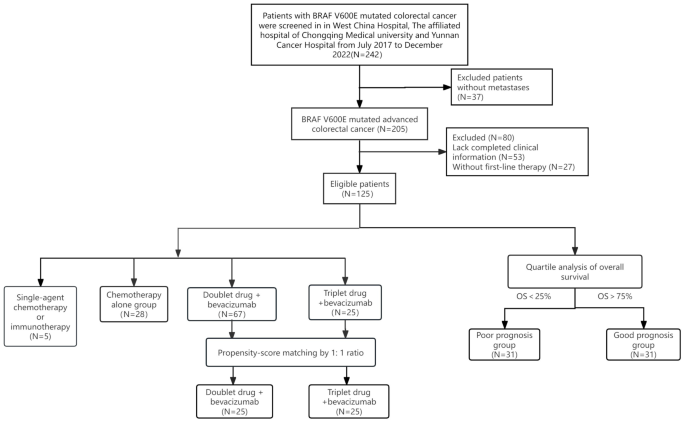
Flow diagram of patient selection
The overall survival and quartile analysis
For the 125 patients with BRAF V600E-mutated mCRC, the median follow-up time was 22.4 months (95% CI 19.6–25.1months), the median OS was 14.9 months (95% CI 12.6–18.9 months), and the median PFS of first-line therapy was 6.10 months (95%CI 5.23–7.70 months) (Fig. 2). We divided the OS of the enrolled patients by quartile method, and the quartile interval was 1.5–7.15 months, 7.15–10.73 months, 10.75–17.1 months, and 17.1-69.23 months, respectively. Patients with OS less than 7.15 months were included into the poor prognosis group, and patients with OS more than 17.1 months were included into the good prognosis group. The median OS of the two groups was 29.2 months and 6.0 months, respectively. The difference in baseline variables between the two groups showed that the poor prognosis group was associated with poor differentiation, multiple organ metastasis and liver metastasis (p < 0.050).

Kaplan–Meier survival curves for all enrolled BRAF V600E-mutated mCRC patients: (a) overall survival of patients, (b) progression-free survival of patients
Univariate and multivariate analysis
In univariate analysis of OS, the following factors, including age, ECOG PS score, grade, liver metastasis, and first-line therapy regimen were associated with OS (p < 0.050). The above variables were included in the multivariate analysis. Based on multivariate analysis, variables such as age>60, poor differentiation, liver metastasis, and first-line doublet regimen were associated with worse OS in patients with BRAF V600E-mutated mCRC (Table 2). Combined with quartile analysis, we further verified that poor differentiation and liver metastasis were independent predictors of OS in patients with BRAF V600E-mutated mCRC.
First-line therapy efficacy and survival analysis
The overall response of all the enrolled patients before and after PSM is summarized in Table 3. No significant differences in ORR and DCR were found in the doublet group and triplet group before and after PSM (Table 3).
Regarding survival, the median OS was significantly improved in the triplet group compared to that in doublet-drug group (17.4 vs. 13.4 months, p = 0.022). While median PFS was improved without significant differences (8.5 vs. 6.5 months, p = 0.140) (Fig. 3). After PSM, the trend for OS remained and became more obvious (17.4 vs. 10.4 months, p = 0.004). A similar prognostic trend for PFS was observed in the matched cohort (Fig. 3).

Kaplan–Meier survival curves for BRAF V600E-mutated patients before and after matching: (a) overall survival of patients before matching, (b) progression-free survival of patients before matching, (c) overall survival of patients in the matched cohort, and (d) progression-free survival of patients in the matched cohort
Stratified analysis
Patients in the triplet group had a better prognosis with the following beneficial factors: younger age (< 60 years old), better ECOG PS score (0–1), multiple metastatic organs, and presence of liver metastases (Fig. 4).

Stratified analysis for overall survival in BRAF V600E-mutated mCRC patients
Discussion
In our study, BRAF V600E-mutated mCRC were more likely to be located in the right colon and more common in older female. We also found that BRAF V600E-mutated mCRC was associated with aggressive behaviors: the majority of patients had synchronous metastases, and multiple organ involvement, affecting more frequently distant lymph node, liver, and peritoneum and less frequently lungs, which was consistent with previous studies [8, 16]. Notably, only 4.8% of the BRAF V600E mutated tumors in our study were dMMR. This proportion is obviously lower than that in previous studies in European countries (37.2%) [17] and in Sweden (50.0%) [18]. In another retrospective study conducted from Sun Yat-sen University in China [19], the incidence of dMMR in BRAF V600E-mutated mCRC patients was only 1.9%. Therefore, the difference between countries may be due to racial differences.
Many studies have investigated prognostic factors in BRAF V600E-mutated mCRC. One study found that MMR, primary tumor resection, and metastasis resection were positively associated with survival, and they also reported that the neutrophil-to-lymphocyte ratio ≥ 3, the serum albumin levels ≥ 3.6 g/dL, and systemic inflammation score of 1–3 were associated with significantly improved OS [20]. While synchronous metastases, and absence of curative surgery, were statistically associated with poor survival in patients with BRAF V600E mutation [21]. In our study, according to multivariate analysis and quartile analysis, liver metastasis and poor differentiation were identified as negative independent predictors of OS in patients with BRAF V600E-mutated mCRC.
In terms of treatment efficacy, the ORR and DCR of patients receiving triplet therapy were numerically higher than those in doublet group, without reaching statistical significance before and after PSM. The results were consistent with the TRIBE, TRIBE-2 and the individual patient data meta-analysis of FOLFOXIRI plus bevacizumab [11,12,13]. After PSM, the OS of patients treated with first-line triplet was still significantly longer than that of doublet patients (p = 0.004) and there was still no difference in median PFS (p = 0.120). We further performed subgroup analysis of OS and found that the triplet-drug regimen appears to be associated with a better prognosis in patients with better baseline status and higher tumor burden.
The study had the following limitations: first, it was a retrospective study with a small sample size, and the treatment regimen was chosen by different investigators, which may have led to potential selection bias. Second, all the patients enrolled in our study were Chinese. Nevertheless, this will help to explore the characteristics of the Asian population with BRAF V600E-mutated mCRC. Further prospective clinical trials in larger cohorts are warranted to validate the results of this study.
Future perspectives
Our study found that liver metastasis was the negative independent predictor of OS in patients with BRAF V600E-mutated mCRC. Clinically, BRAF V600E-mutated mCRC patients with liver metastasis had a worse prognosis, which may be attributed to the local microenvironment of liver metastasis. In the future, basic experiments are needed to explore the relationship between the microenvironment of liver metastases and tumor progression.
Conclusion
BRAF V600E-mutated mCRC was associated with a poor prognosis. The proportion of patients treated with three-drug combined bevacizumab is relatively low. Poor differentiation and liver metastases were negative independent prognostic factors for OS. The first-line triplet chemotherapy combined with bevacizumab group was associated with better OS, especially in patients with good physical condition and high tumor burden.
Data availability
If you need the data, please contact the corresponding author (qiumeng@wchscu.cn).
References
Davies H, et al. Mutations of the BRAF gene in human cancer. Nature. 2002;417:949–54. https://doi.org/10.1038/nature00766
Afrăsânie VA, et al. KRAS, NRAS, BRAF, HER2 and microsatellite instability in metastatic colorectal cancer - practical implications for the clinician. Radiol Oncol. 2019;53:265–74. https://doi.org/10.2478/raon-2019-0033
Tabernero J, Ros J, Élez E. The Evolving Treatment Landscape in BRAF-V600E-Mutated Metastatic Colorectal Cancer. American Society of Clinical Oncology educational book. American Society of Clinical Oncology. Annual Meeting 42, 1–10, https://doi.org/10.1200/edbk_349561 (2022).
Sinicrope FA, et al. Molecular markers identify subtypes of stage III colon cancer associated with patient outcomes. Gastroenterology. 2015;148:88–99. https://doi.org/10.1053/j.gastro.2014.09.041
Kayhanian H, et al. Treatment and survival outcome of BRAF-Mutated metastatic colorectal Cancer: a Retrospective Matched Case-Control Study. Clin Colorectal Cancer. 2018;17:e69–76. https://doi.org/10.1016/j.clcc.2017.10.006
Clarke CN, Kopetz ES. BRAF mutant colorectal cancer as a distinct subset of colorectal cancer: clinical characteristics, clinical behavior, and response to targeted therapies. J Gastrointest Oncol. 2015;6:660–7. https://doi.org/10.3978/j.issn.2078-6891.2015.077
Grothey A, Fakih M, Tabernero J. Management of BRAF-mutant metastatic colorectal cancer: a review of treatment options and evidence-based guidelines. Annals Oncology: Official J Eur Soc Med Oncol. 2021;32:959–67. https://doi.org/10.1016/j.annonc.2021.03.206
Tran B, et al. Impact of BRAF mutation and microsatellite instability on the pattern of metastatic spread and prognosis in metastatic colorectal cancer. Cancer. 2011;117:4623–32. https://doi.org/10.1002/cncr.26086
Kopetz S, et al. Encorafenib, Binimetinib, and Cetuximab in BRAF V600E-Mutated colorectal Cancer. N Engl J Med. 2019;381:1632–43. https://doi.org/10.1056/NEJMoa1908075
Benson AB, et al. Colon cancer, Version 2.2021, NCCN Clinical Practice guidelines in Oncology. J Natl Compr Cancer Network: JNCCN. 2021;19:329–59. https://doi.org/10.6004/jnccn.2021.0012
Cremolini C, et al. FOLFOXIRI plus bevacizumab versus FOLFIRI plus bevacizumab as first-line treatment of patients with metastatic colorectal cancer: updated overall survival and molecular subgroup analyses of the open-label, phase 3 TRIBE study. Lancet Oncol. 2015;16:1306–15. https://doi.org/10.1016/s1470-2045(15)00122-9
Cremolini C, et al. Upfront FOLFOXIRI plus bevacizumab and reintroduction after progression versus mFOLFOX6 plus bevacizumab followed by FOLFIRI plus Bevacizumab in the treatment of patients with metastatic colorectal cancer (TRIBE2): a multicentre, open-label, phase 3, randomised, controlled trial. Lancet Oncol. 2020;21:497–507. https://doi.org/10.1016/s1470-2045(19)30862-9
Cremolini C, et al. Individual Patient Data Meta-Analysis of FOLFOXIRI Plus Bevacizumab Versus doublets Plus Bevacizumab as initial therapy of unresectable metastatic colorectal Cancer. J Clin Oncology: Official J Am Soc Clin Oncol. 2020;Jco2001225. https://doi.org/10.1200/jco.20.01225
Eisenhauer EA, et al. New response evaluation criteria in solid tumours: revised RECIST guideline (version 1.1). Eur J cancer (Oxford England: 1990). 2009;45:228–47. https://doi.org/10.1016/j.ejca.2008.10.026
von Elm E, et al. The strengthening the reporting of Observational studies in Epidemiology (STROBE) statement: guidelines for reporting observational studies. Lancet (London England). 2007;370:1453–7. https://doi.org/10.1016/s0140-6736(07)61602-x
Yaeger R, et al. BRAF mutation predicts for poor outcomes after metastasectomy in patients with metastatic colorectal cancer. Cancer. 2014;120:2316–24. https://doi.org/10.1002/cncr.28729
Digiacomo N, et al. Neuroendocrine differentiation, microsatellite instability, and Tumor-infiltrating lymphocytes in Advanced Colorectal Cancer with BRAF Mutation. Clin Colorectal Cancer. 2019;18:e251–60. https://doi.org/10.1016/j.clcc.2018.12.003
Seppälä TT, et al. Combination of microsatellite instability and BRAF mutation status for subtyping colorectal cancer. Br J Cancer. 2015;112:1966–75. https://doi.org/10.1038/bjc.2015.160
Guan WL, et al. Clinicopathologic features and prognosis of BRAF mutated Colorectal Cancer patients. Front Oncol. 2020;10:563407. https://doi.org/10.3389/fonc.2020.563407
Martínez-Lago N, et al. Effect of antiangiogenic-based treatment and systemic inflammatory factors on outcomes in patients with BRAF v600-mutated metastatic colorectal cancer: a real-world study in Spain. BMC Cancer. 2021;21:64. https://doi.org/10.1186/s12885-020-07758-5
de la Fouchardière C, et al. Characteristics of BRAF(V600E) mutant, deficient mismatch Repair/Proficient mismatch repair, metastatic colorectal Cancer: a Multicenter Series of 287 patients. Oncologist. 2019;24:e1331–40. https://doi.org/10.1634/theoncologist.2018-0914
Acknowledgements
None.
Funding
This work was supported by the Sichuan Science and Technology Department Key Research and Development Project (grant no. 2022YFS0209) and 1.3.5 Project for Disciplines of Excellence, West China Hospital, Sichuan University (grant no. ZYJC21017).
Author information
Authors and Affiliations
Contributions
Gui-Xia Wei collected data, reviewed the literature, and wrote the manuscript. Yu-Wen Zhou and Chao Dong collected data and wrote and revised the manuscript. Tao Zhang assisted in drawing. Peng Cao rechecked the manuscript. Lin Xie and Meng Qiu designed and revised the manuscript. All authors contributed to the article and approved the submitted version.
Corresponding authors
Ethics declarations
Ethics approval and consent to participate
The study was approved by the Institutional Review Board of West China Hospital, Sichuan University, Chengdu, China [Approval number: 2022 Review (NO.807)].
Consent to participate
This is a retrospective observational study, so patients ' informed consent is not required. And this was approved by the Institutional Review Board of West China Hospital, Sichuan University.
Consent for publication
Not applicable.
Competing interests
The authors declare no competing interests.
Additional information
Publisher’s note
Springer Nature remains neutral with regard to jurisdictional claims in published maps and institutional affiliations.
Electronic supplementary material
Below is the link to the electronic supplementary material.
Rights and permissions
Open Access This article is licensed under a Creative Commons Attribution-NonCommercial-NoDerivatives 4.0 International License, which permits any non-commercial use, sharing, distribution and reproduction in any medium or format, as long as you give appropriate credit to the original author(s) and the source, provide a link to the Creative Commons licence, and indicate if you modified the licensed material. You do not have permission under this licence to share adapted material derived from this article or parts of it. The images or other third party material in this article are included in the article’s Creative Commons licence, unless indicated otherwise in a credit line to the material. If material is not included in the article’s Creative Commons licence and your intended use is not permitted by statutory regulation or exceeds the permitted use, you will need to obtain permission directly from the copyright holder. To view a copy of this licence, visit http://creativecommons.org/licenses/by-nc-nd/4.0/.
About this article

Cite this article
Wei, GX., Zhou, YW., Dong, C. et al. Clinicopathologic features and treatment efficacy of patients with BRAF V600E-mutated metastatic colorectal cancer: a multi-center real-world propensity score matching study. BMC Cancer 24, 1395 (2024). https://doi.org/10.1186/s12885-024-13171-z
Received:
Accepted:
Published:
Version of record:
DOI: https://doi.org/10.1186/s12885-024-13171-z